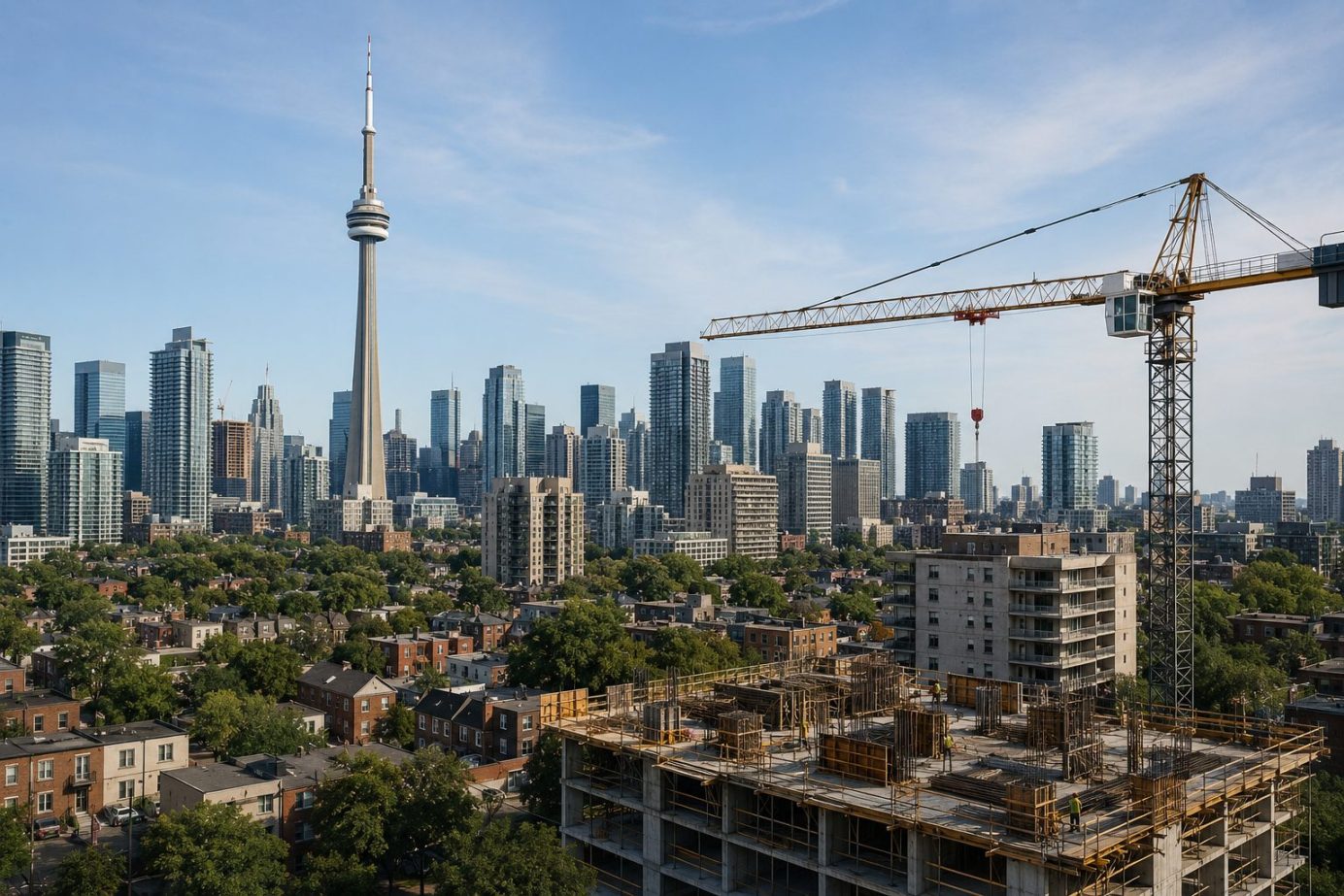
Housing affordability has been one of the biggest political and economic issues in Canada for years, but the debate is becoming particularly interesting in Toronto.
Governments are now putting significant amounts of public money behind housing construction. Some of that assistance comes in the form of direct funding. Some comes through low-cost government-backed financing. Other programs reduce or defer development charges, provide municipal land or offer incentives intended to make projects financially viable.
That raises an understandable question:
Should taxpayers really be helping developers build housing?
And perhaps the more important question for anyone buying, selling or investing in Toronto real estate is:
Will giving developers financial assistance actually make homes in Toronto more affordable?
The answer is complicated.
In my view, targeted government support for housing construction makes sense in the current Toronto market — but simply handing money to developers will not solve Toronto’s housing crisis.
The real objective should be getting homes that would otherwise not be built out of the planning stage and into construction.
The Canadian Government Is Already Putting Billions Into Toronto Housing
This is no longer a theoretical discussion.
On August 5, 2026, the federal government and the City of Toronto announced a major housing partnership involving 18 Toronto projects expected to produce more than 5,600 rental homes. The package includes more than $310 million through Build Canada Homes, more than $1.8 billion in low-cost financing through CMHC’s Apartment Construction Loan Program, and up to another $600 million of potential financing for future Toronto projects.
Importantly, this is not simply the federal government writing cheques to private developers.
Build Canada Homes is supporting non-market housing projects on City-owned land, while the Apartment Construction Loan Program provides low-cost financing for purpose-built rental construction. Loans are very different from grants because the funds are generally expected to be repaid.
Toronto is also receiving up to $1.5 billion in federal and provincial infrastructure funding connected to the City’s commitment to reduce residential development charges. Toronto says those reductions will range from approximately 40% to 60% between 2026 and 2029, depending on the type of unit.
So the better question may not be whether governments should “give developers money.”
The question is whether governments should use financing, tax incentives, land and development-charge reductions to make housing projects economically possible.
In Toronto right now, there is a strong argument that they should.
Toronto Has a Housing Problem — But It Is Also Developing a Construction Problem
Anyone watching the Toronto real estate market in 2026 might reasonably ask why the government needs to stimulate construction at all.
After all, Toronto home prices have softened.
In July 2026, the average Greater Toronto Area selling price was approximately $1,003,956, down 4.5% from July 2025. The MLS Home Price Index benchmark was also down 4.6% year-over-year.
At first glance, that sounds like the housing shortage may be correcting itself.
Unfortunately, the current resale market and the future housing supply pipeline are two very different things.
CMHC’s 2026 Housing Market Outlook specifically warns that new housing construction is expected to decline and identifies Toronto’s condominium market as a particular concern. Toronto pre-construction condominium sales fell to multi-decade lows in 2025, making financing thresholds increasingly difficult for developers to meet. As a result, projects have been delayed or cancelled.
That creates a potentially dangerous lag.
A condominium project that does not sell enough units in 2026 may never start construction in 2027.
That means those homes do not arrive in 2029, 2030 or 2031.
Toronto could therefore experience a strange situation where there appears to be plenty of housing inventory today while simultaneously creating the conditions for another housing shortage several years from now.
Why Would a Developer Need Government Assistance?
There is sometimes an assumption that because Toronto real estate has historically been profitable, developers should simply build housing without government assistance.
But development economics are more complicated than that.
Before a shovel goes into the ground, a developer may face land acquisition costs, financing costs, planning expenses, municipal fees, consultants, construction costs, development charges and years of carrying costs.
For condominium developments, lenders generally require substantial pre-sales before advancing construction financing.
If buyers will not purchase enough pre-construction units at prices high enough to make the project viable, construction may simply never begin.
CMHC says developers currently face a combination of high construction costs, weaker demand and inventories of unsold units, with Toronto condominium projects particularly affected by weak pre-construction sales.
Government-backed low-cost financing can therefore make a real difference.
If the government reduces the borrowing cost of a rental project, or the City reduces the development charges payable on a new development, a project that previously produced an unacceptable return may suddenly become financially workable.
And if the project becomes viable, the result is relatively straightforward:
housing actually gets built.
Toronto Development Charges Are Now Part of the Housing Debate
One of the most significant developments in the Toronto housing market this year may actually have less to do with mortgages or interest rates and more to do with municipal development charges.
Toronto announced in June 2026 that residential development charges would be reduced by
approximately 40% to 60% for more than three years under a funding arrangement involving the City, Ontario and the federal government.
The logic behind the policy is important.
Development charges help municipalities pay for infrastructure required to support growth. Toronto still needs transit, roads, water infrastructure and other services when thousands of new residents move into newly constructed communities.
Simply eliminating those charges could therefore create another problem: the City would still need to pay for the infrastructure.
The new approach attempts to address both issues.
Federal and provincial governments provide infrastructure funding while Toronto reduces the amount developers must pay upfront.
If implemented properly, that can reduce the cost of creating new housing without simply transferring infrastructure costs onto Toronto property taxpayers
.
The City itself says the reductions are intended to lower development costs, improve project viability and increase Toronto’s housing supply.
That is a much more compelling form of housing policy than simply providing an unrestricted subsidy.
But Will Giving Developers Money Make Toronto Homes Cheaper?
This is where expectations need to be realistic.
Probably not immediately.
If the federal government announces $1 billion in housing financing tomorrow, Toronto home prices are not suddenly going to fall next month.
Housing construction takes years.
CMHC notes that rezoning and development approvals can themselves take multiple years before the actual construction period even begins.
The benefit of developer incentives therefore needs to be measured over a much longer period.
More housing construction increases the number of homes competing for renters and purchasers.
That does not necessarily mean Toronto real estate prices fall dramatically. It may instead mean prices and rents increase more slowly than they otherwise would have.
That distinction is important.
Imagine Toronto requires 100,000 additional homes but only builds 60,000.
Prices could rise considerably.
If government incentives help increase construction to 90,000 homes, housing may still become more expensive — but significantly less expensive than it would have been if only 60,000 homes were constructed.
We never get to observe the alternative universe where those homes were not built.
That makes successful housing policy politically difficult because preventing a future shortage does not always look like an immediate reduction in today’s home prices.
CMHC Says Toronto Needs Significantly More Construction
The scale of the supply problem is enormous.
CMHC estimates Canada would need roughly 430,000 to 480,000 housing starts annually over the next decade to restore housing affordability to approximately 2019 levels — close to double the projected pace of construction.
Toronto faces a particularly significant challenge.
CMHC estimates that the Toronto region would require approximately a 70% increase in homebuilding over the next decade to improve affordability. CMHC has also specifically identified a shortage of homeownership options that align with local incomes.
That last point deserves considerably more attention.
Toronto does not simply need more housing.
Toronto needs the right housing.
Building thousands of expensive rental units does not necessarily solve the problem facing a young couple trying to purchase their first home.
Building luxury condominiums does little for a family searching for a three-bedroom property.
And supportive housing addresses a completely different segment of the housing market.
A successful Toronto housing strategy therefore needs multiple forms of construction operating simultaneously.
The Biggest Risk: Subsidizing Development That Would Have Happened Anyway
Government incentives are not automatically good housing policy.
There is always a legitimate concern that taxpayers could end up subsidizing developments that would have proceeded without public assistance.
That would accomplish very little.
The strongest housing programs should therefore prioritize projects where government assistance actually changes the outcome.
For example, funding could be tied to projects that are construction-ready but unable to obtain economical financing.
Development-charge reductions could be conditional on construction beginning within a specified period.
Affordable housing incentives should contain meaningful affordability requirements.
Public land partnerships should ensure taxpayers receive a long-term housing benefit rather than simply transferring valuable land to private interests.
And government should publish enough information for the public to determine how much money was spent, how many units were created and how quickly they were delivered.
The appropriate question should always be:
Did this government assistance result in homes being built that otherwise would not have been built?
If the answer is yes, the program may represent good public policy.
If the answer is no, taxpayers have simply increased a developer’s return.
Government Funding Cannot Fix Toronto Housing by Itself
Financing is only one piece of the Toronto housing puzzle.
CMHC itself has said that dramatically increasing housing construction will require more private investment, a larger workforce, productivity improvements, construction innovation and changes that reduce regulatory delays and development costs.
In other words, governments cannot spend their way out of the housing crisis while leaving every other obstacle unchanged.
Toronto still needs faster and more predictable development approvals.
Ontario needs enough skilled construction workers to build the housing being approved.
Municipalities need infrastructure capable of supporting greater density.
Developers need access to financing.
And buyers need sufficient income and borrowing capacity to purchase the homes being constructed.
All of those factors interact.
There is little value in approving 100,000 homes if financing makes them impossible to build.
There is equally little value in providing cheap financing if projects remain trapped in the approval process for years.
The Toronto Condo Market Deserves Special Attention
Perhaps the most concerning part of the current Toronto housing market is the condominium construction pipeline.
Toronto has historically relied heavily on pre-construction condominium sales to finance new high-density housing.
The model generally requires developers to sell a significant percentage of the building before construction financing becomes available.
When investors and end-users stop buying pre-construction units, the entire system slows.
CMHC says Toronto pre-construction sales reached multi-decade lows in 2025 and that condominium starts are expected to remain particularly weak.
That means the federal government’s current emphasis on purpose-built rental construction may help maintain overall housing construction, but it does not completely solve Toronto’s future ownership supply problem.
This is an important distinction for Toronto homebuyers.
A healthy rental market and a healthy ownership market are related, but they are not interchangeable.
Toronto needs both.
So, Should Canada Be Funding Developers Right Now?
Yes — but with conditions.
Toronto is facing a situation where housing remains extremely expensive while the economics of constructing new housing have deteriorated.
Allowing the development pipeline to collapse because we dislike the idea of government assisting developers would be shortsighted.
If Toronto significantly reduces housing starts today, the consequences may not become obvious until several years from now, when today’s cancelled projects should have been reaching completion.
At the same time, government assistance should not become an unrestricted transfer of taxpayer money to profitable development companies.
The better model is targeted assistance:
Low-cost loans rather than unrestricted grants where possible.
Development-charge reductions tied to actual construction.
Public land partnerships that produce affordable or rent-controlled housing.
Financial incentives for projects that can start construction quickly.
Long-term affordability requirements where public subsidies are significant.
And transparent reporting so taxpayers can determine whether the programs actually produced additional housing.
Government should not be in the business of guaranteeing developer profits.
Government should be in the business of removing the barriers preventing necessary housing from being built.
There is a major difference between the two.
What Does This Mean for the Toronto Housing Market?
For Toronto buyers and sellers, the important point is that today’s relatively softer housing market should not be mistaken for evidence that Toronto’s long-term housing shortage has disappeared.
July 2026 GTA prices remained lower than the year before, with the average selling price just over $1 million.
At the same time, CMHC is warning about weak condominium construction and estimating that Toronto requires dramatically more housing over the next decade to improve affordability.
Those two things can exist at the same time.
The Toronto real estate market is cyclical.
The Toronto housing shortage is structural.
Government financing may help prevent today’s construction slowdown from becoming tomorrow’s supply crisis.
But it will take years before we know whether these programs actually worked.
Frequently Asked Questions About Government Funding and the Toronto Housing Market
Is the Canadian government giving money directly to Toronto developers?
Some programs involve direct government funding, while others involve low-cost loans, public land partnerships, development-charge reductions or other incentives. For example, the August 2026 Toronto housing announcement includes both Build Canada Homes funding and more than $1.8 billion in low-cost CMHC financing.
Will government funding make Toronto houses cheaper?
Not necessarily in the short term. The more realistic objective is to increase housing supply over several years, which can reduce upward pressure on Toronto home prices and rents compared with what might occur if construction remains depressed.
Why are Toronto developers not simply building more condos?
CMHC has identified high construction costs, weaker demand, unsold inventory and difficulty reaching financing thresholds as major obstacles. Toronto condominium pre-construction sales were particularly weak in 2025.
Are Toronto development charges being reduced?
Yes. Toronto announced reductions of approximately 40% to 60%, depending on housing type, supported by up to $1.5 billion in federal and provincial infrastructure funding.
Does Toronto actually need more housing?
CMHC estimates Toronto would need approximately 70% more homebuilding over the next decade to meaningfully improve affordability.
Buying, Selling or Investing in Toronto Real Estate?
Government housing policies, development incentives and changes in Toronto’s real estate market can affect buyers, sellers, investors, landlords and developers in very different ways.
Whether you are purchasing your first Toronto home, buying or selling a condominium, investing in Toronto real estate, refinancing a property or completing a commercial real estate transaction, obtaining legal advice early in the process can help identify issues before they become expensive problems.
Capulli Law LLP is a Toronto real estate law firm assisting clients with residential and commercial real estate transactions throughout Toronto and the Greater Toronto Area.
Contact us to discuss your next Toronto real estate transaction.
This article is provided for general information only and does not constitute legal, financial or investment advice.
Related Articles:
Toronto Land Transfer Tax in 2026: What Home Buyers Need to Budget Before Closing
Why You Should Have a Real Estate Lawyer Review Your Offer Before Signing
Independent Legal Advice in Toronto: Why You Should Never Sign Important Documents Without It